
Flash, debug, and inspect any ESP32 from your browser.
A browser-based serial console and flash-management workbench for ESP32-family microcontrollers. Over USB or the network. No CLI, no toolchain install.
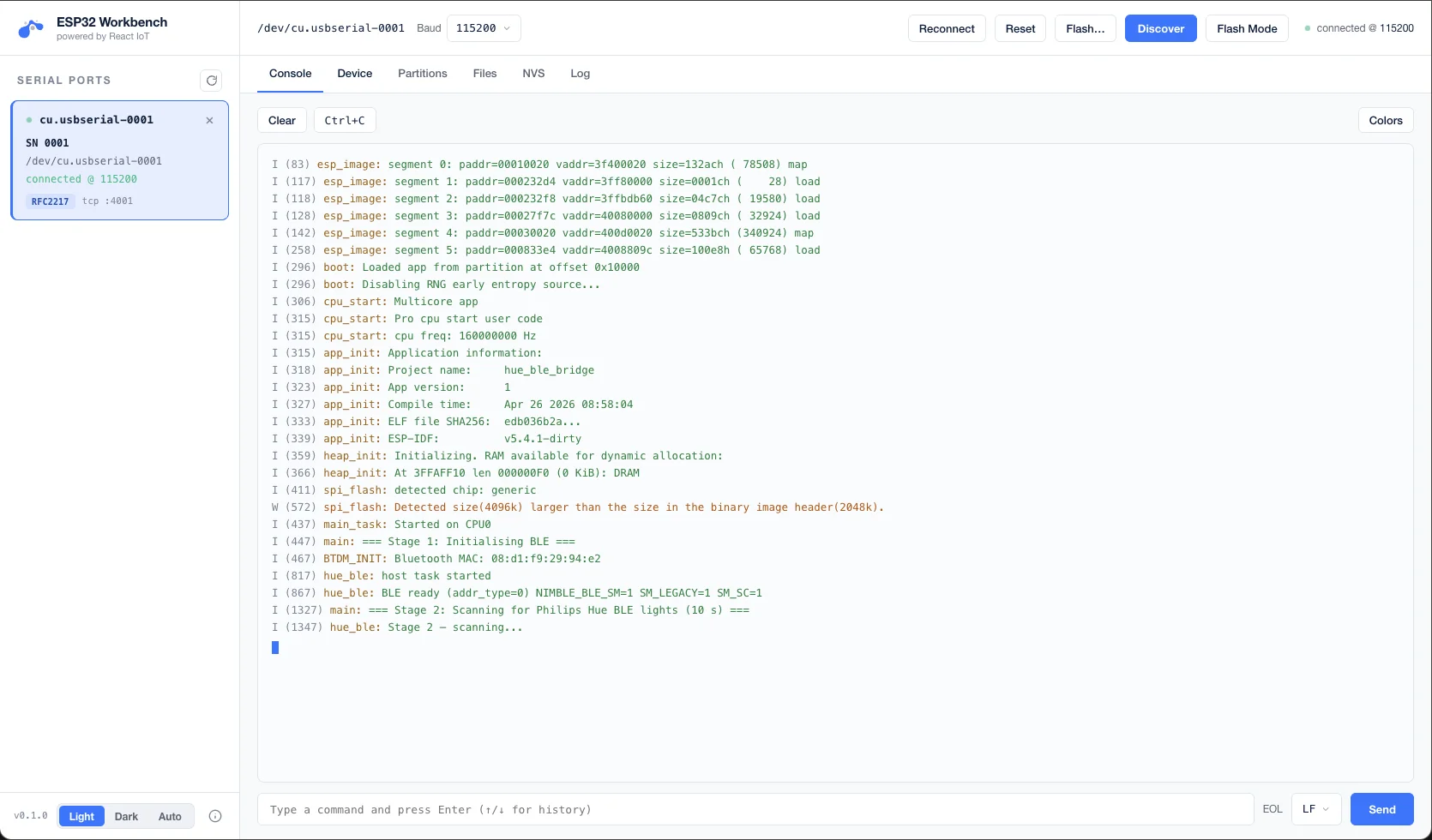
Replace the esptool + monitor + partition juggle
A single self-hosted web app for device bring-up, provisioning, QA and field support — over USB or across the network.
Self-hosted, browser client
Install it once on a Raspberry Pi or Linux box; everyone else just opens a browser. No esptool or Python toolchain on operator machines — onboard non-experts in seconds.
USB and network
Reach a board at the bench or in a rack, lab or field from your desk — Web Serial over USB and RFC2217 over TCP, with mDNS auto-discovery.
Self-hosted & private
Runs on infrastructure you control, from one Docker container. Firmware and device data never leave your network.
From connect to inspect
Grouped the way you actually work — connect to a board, discover what's on it, flash and verify, then inspect and log.
Browser-based client
Runs on a Raspberry Pi or Linux host; operators just open a browser. No esptool or Python toolchain on their machines.
USB and network serial
RFC2217 serial over TCP means you can flash and debug devices at the bench or in a rack, lab or field — from your desk.
mDNS auto-discovery
Networked devices appear in the sidebar automatically — no hunting for IP addresses or COM ports.
Multi-port
Open several consoles side by side and work across a whole fleet of boards at once.
Shared live console
Multiple people can watch one device's console stream at once — humans in the UI and scripts on the raw TCP socket, tailing the same board together.
MCP for agents
An MCP interface exposes discover, flash and serial over the same workbench — so AI agents can bring up, flash and monitor boards alongside your team.
One-pass Discover
Chip info, partition table, OTA slots and NVS — all read in a single click.
Chip detection
Chip type, package, revision, MAC, crystal, flash size, features and firmware banner — confirm the hardware before you flash.
Partition & OTA map
A flash-layout map — app, data, unused, OTA slots — with per-entry offset, size and encryption. Audit layout at a glance.
NVS inspector
Browse namespaces, keys, types and values — debug stored config and provisioning without a reflash.
Firmware flashing
Pick a binary and an offset — bootloader, partition table, app or custom — with optional full-chip erase and live progress.
MD5 verify
Hash any offset and length to prove a flash wrote correctly — before you ship the board.
Serial console
A real terminal built on xterm.js: baud select, line-ending control, Ctrl+C, colors and clear.
Filesystem browser
List, refresh and upload files on SPIFFS, LittleFS or FATFS — manage assets without a reflash.
Per-device log history
Persistent, rotating session logs per device — scroll back hours later to see what a board actually did.
Self-hosted & private
Runs on your own server; firmware and device data stay on your network.
Hit Discover. See the whole board.
One pass reads chip info, the partition table, OTA slots and NVS — so you understand a device before you touch its flash. No four separate commands, no guessing at the layout.
Chip & MAC
Type, revision, crystal, flash size and features.
Flash-layout map
App, data, unused and OTA slots, drawn to scale.
Per-entry detail
Offset, size and encryption flags for every partition.
| partition | offset | size | enc |
|---|---|---|---|
| ota_0 | 0x10000 | 2.5 MB | ✓ |
| ota_1 | 0x290000 | 2.5 MB | ✓ |
| nvs | 0x9000 | 24 KB | — |
Local over USB, remote over TCP — same UI
Locally it's Web Serial straight to the port. Remotely, a tiny bridge exposes the board as a TCP serial socket (RFC2217) — the same console and the same flash, from anywhere.
1 · Web UI + scripts
Operators use the browser console; scripts and CI connect to the same board over a raw TCP serial socket.
2 · Serial bridge
A lightweight bridge on the host exposes each board as a TCP serial endpoint (RFC2217) and advertises it over mDNS.
3 · Your board
The ESP32 connects over USB/UART to the host — at the bench, in a rack, or out in the field.
Built for everyone who touches an ESP32
Bring-up, provisioning, QA and field support — one tool the whole team can open, no toolchain required.
Firmware engineers
Bring up a board, tail serial and reflash in seconds — from the browser, without wiring up a local toolchain.
IoT product teams
Provision and QA devices from one shared tool — the same console, partitions and NVS view for everyone.
Hardware manufacturers
Onboard line operators and field-support techs in seconds — flash and verify with no CLI to learn.
Self-hosted · runs on infrastructure you control — firmware and device data stay on your network.
Clone it, run it, ship it
ESP32 Workbench is free and MIT-licensed — part of React IoT's mission to make connecting and working with hardware possible from anywhere. Star the repo, open an issue, or build it into your own tooling.